




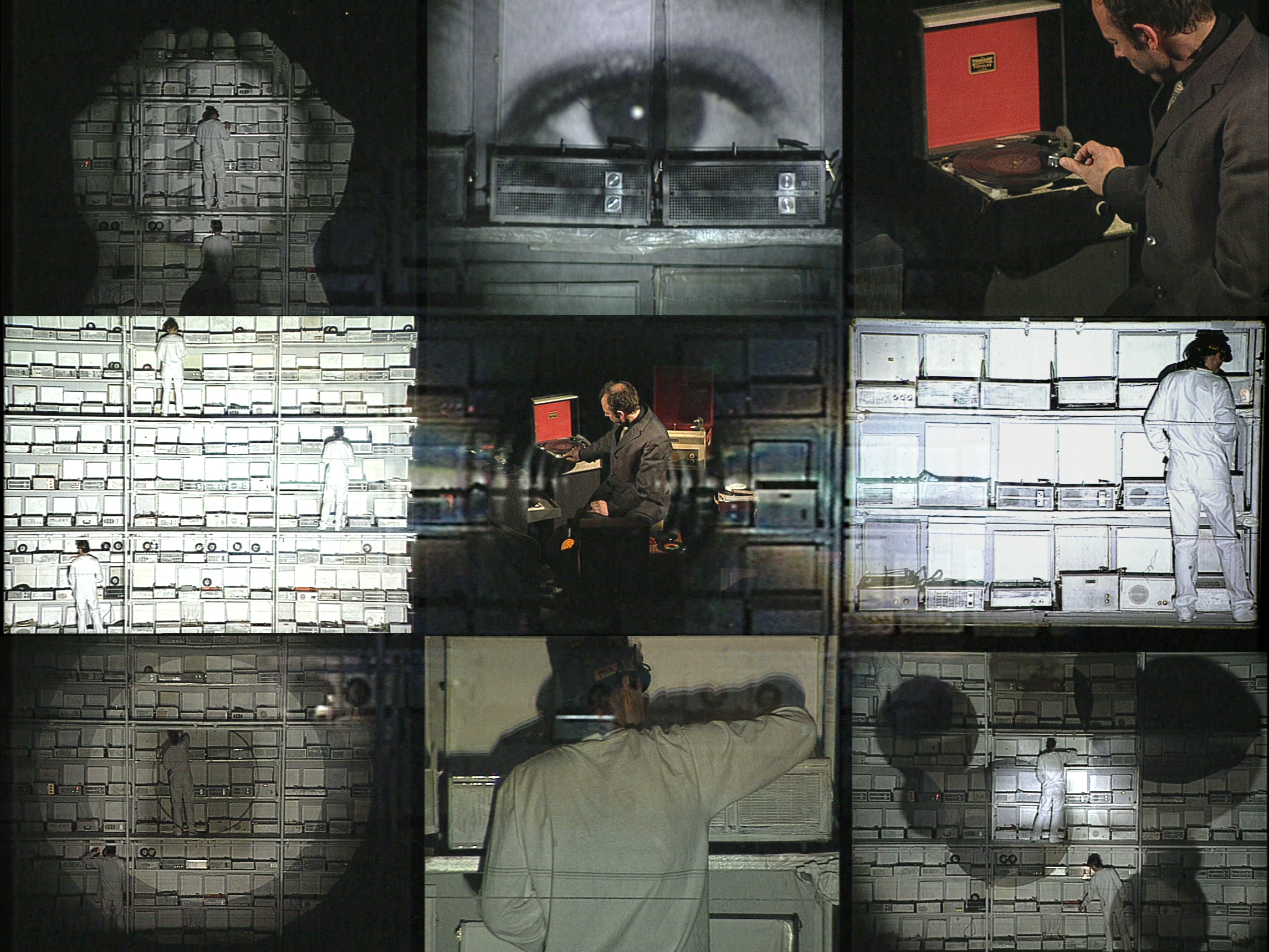
click on image above to play video extract
Union Chapel, London 4th November 2026
33.3 years after 180 Dansette record players transformed Union Chapel, Philip Jeck and Lol Sargent’s Vinyl Requiem returns to the place where it began.
Vinyl Requiem 33.3 – celebrating the 33.3rd anniversary of this monumental audio-visual performance created by British experimental turntablist Philip Jeck and visual artist Lol Sargent. Presented by The Philip Jeck Foundation in association with Union Chapel. Built around 180 Dansette record players, with 16mm film and slide projections, Vinyl Requiem was played across an immense wall of turntables.
The original production won the 1993 Time Out London Dance & Performance Award for Best Site Specific Event and became a landmark in Jeck’s pioneering practice with turntables and found recordings.
More than a conventional archival screening, Vinyl Requiem 33.3 is an opportunity to encounter the scale and atmosphere of this extraordinary work in its original home.
Created at a moment when vinyl appeared to be heading towards obsolescence, Vinyl Requiem transformed the machinery of recorded music into an extraordinary architecture of sound and image. Records were slowed, looped, layered and allowed to decay into one another, creating a work about memory, repetition, loss, technology and our relationship with recorded sound.
Vinyl Requiem’s 55 minute film returns to the place where it began, replayed as a full-scale projection, at its 1993 premier at Union Chapel. Followed by a Q&A hosted by Jon Wozencroft (Touch) with Ghislaine Boddington (Artistic Director, Shinkansen), Gavin Bryars (Composer & Musician), Mary Prestidge (The Philip Jeck Foundation), Donna Rutherford (Vinyl Requiem Operator) and Lol Sargent (visual artist).
The event also sees the launch of a double-vinyl edition of Vinyl Requiem, released on Touch. More information can be found about this release here.
Programme (doors 6.30PM):
Main chapel –
Run in groove
Film (55 minutes)
Q&A (30 minutes)
Run out groove… transition to the bar:
An installation of Philip’s original Dansettes playing vinyl back onto vinyl, and showing the original Betacam SP 78 minute film, shot by Sholto Ramsay.
Philip was clear that Vinyl Requiem was not “a big mourning for records, I am not anti CD. It is a good starting point to mark this time of change from vinyl to other formats.”
“What Philip and I created was an abstract expressionistic performance made in a very intuitive way to celebrate over 100 years of the mass public experience of the ‘record’. It was an art installation performance about a medium, using the medium.” (Lol Sargent)
“Lol uses his computer-controlled projectors as paint brushes. He paints with light which is similar to the way that I work with sound.” (Philip Jeck)
“…they go where others do not dare.” (Robert Maycock, The Independent)
“…a mood of poignancy. Perhaps sadness is intrinsic to the medium.” (David Toop)
“In my head, the way I work, I’m thinking of it in sculptural or painterly terms. Every added sound is a different colour.” (Philip Jeck, interview with Dieter Scheyhing, Positionen)
Image taken from the digitized Betacam SP video filmed on 3rd June preview run at Union Chapel which was shot by Sholto Ramsay.